
Vitamin D and Statins: What the Research Really Says About Their Interaction

Jan, 23 2026
Millions of people take statins to lower cholesterol and protect their hearts. At the same time, nearly half of all Americans take vitamin D supplements-often for bone health, immune support, or because their doctor told them to. But what happens when these two overlap? If you’re on a statin and also taking vitamin D, are you helping yourself-or could you be doing more harm than good?
Why This Matters to You
If you’ve been prescribed a statin and started feeling muscle aches, soreness, or weakness, you’re not alone. About 1 in 3 people on statins report muscle symptoms. It’s so common that many people automatically turn to vitamin D. You’ve probably heard the story: low vitamin D causes muscle pain, so taking a supplement fixes it. It sounds logical. But the science doesn’t back it up.The VITAL trial substudy in 2022, one of the largest and most rigorous studies on this topic, followed over 2,000 people who started statins. Half took vitamin D supplements; half took a placebo. After a year, both groups had the exact same rate of muscle symptoms-31% in each. It didn’t matter if their vitamin D levels were low to begin with. The supplement didn’t help. Not even a little.
How Statins and Vitamin D Are Connected
It’s easy to see why people think there’s a link. Vitamin D is made from cholesterol. Statins block cholesterol production. So, logically, statins should lower vitamin D levels. But that’s not what the data shows.Some studies found the opposite. A 2019 study showed people on statins had higher vitamin D levels than those not taking them. Atorvastatin users had the highest levels-averaging 23 ng/mL compared to 20 ng/mL in controls. Another study in 2012 found rosuvastatin boosted vitamin D levels from 11.8 ng/mL to 35.2 ng/mL in just eight weeks.
So why the contradiction? One theory is that statins might be improving how your body absorbs vitamin D. Some researchers believe statins activate cholesterol transporters in the gut, helping more vitamin D get into your bloodstream. That could explain why certain statins-like atorvastatin and rosuvastatin-seem to raise vitamin D levels, while others don’t.
But here’s the catch: higher vitamin D levels don’t mean fewer muscle symptoms. Even when vitamin D goes up, muscle pain doesn’t go down. That’s the big disconnect.
Which Statins Are Most Likely to Interact?
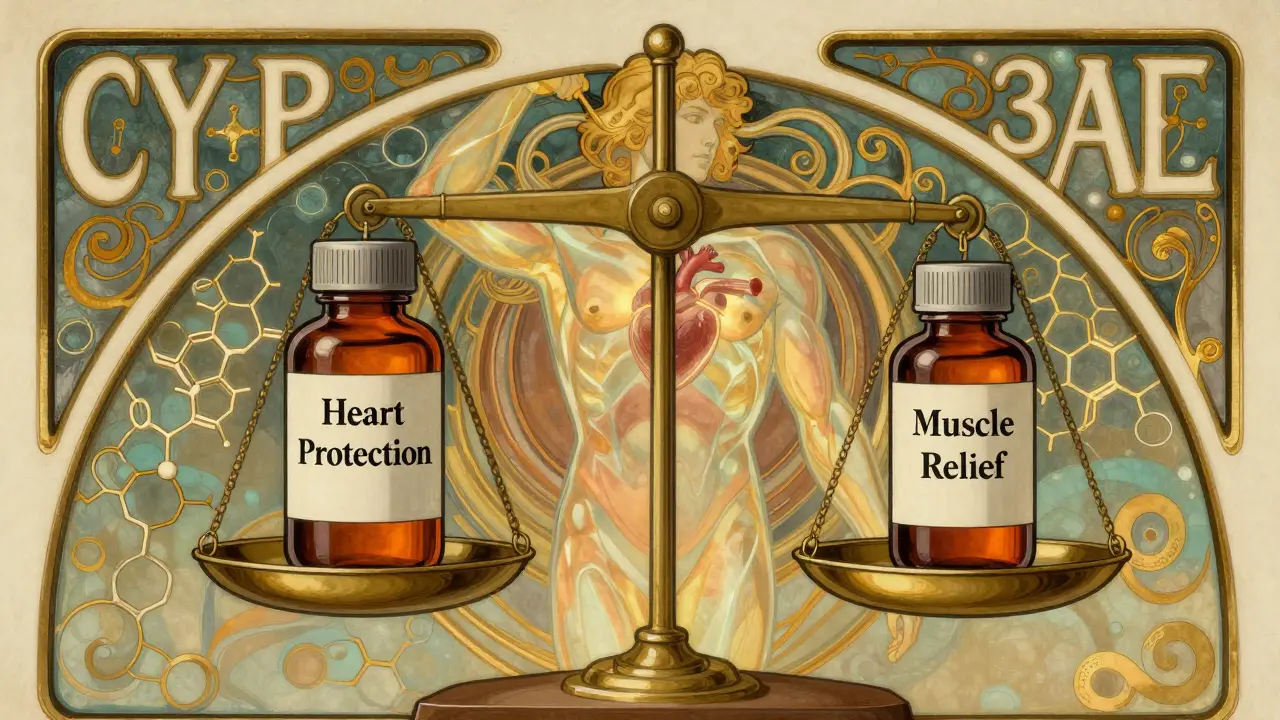
Not all statins are the same. Only three are processed by the liver enzyme CYP3A4: atorvastatin, simvastatin, and lovastatin. These are the ones that might interact with vitamin D supplements-because vitamin D is also broken down by CYP3A4.Some small studies suggest high-dose vitamin D (800 IU or more daily) might slightly lower the concentration of these statins in the blood. That sounds scary, but the drop is tiny-less than 10%-and no one has shown it leads to worse heart outcomes. Still, if you’re on one of these three statins and taking high-dose vitamin D, it’s worth mentioning to your doctor.
On the other hand, statins like rosuvastatin, pravastatin, and fluvastatin don’t rely on CYP3A4. They’re much less likely to interact with vitamin D at all. If you’re having side effects, switching to one of these might be a better move than adding a supplement.
What the Experts Really Say
The American College of Cardiology, the European Society of Cardiology, and the American Heart Association all agree: don’t take vitamin D to prevent statin muscle pain. There’s no good evidence it works.Dr. Mark Hlatky, who led the VITAL trial, put it bluntly: “Vitamin D supplementation does not prevent statin-associated muscle symptoms or reduce statin discontinuation.”
But here’s where it gets messy. Many doctors still recommend it. A 2023 survey found 47% of primary care physicians still suggest vitamin D to statin users-mostly because patients ask for it. And patients? They swear it works. On Reddit, over half of users who tried vitamin D said it helped their muscle pain. Drugs.com reviews show similar results.
So why the gap? Anecdotes are powerful. If you start a supplement and your pain goes away, it’s easy to blame the vitamin D-even if the pain would’ve gone away on its own. Muscle aches from statins often come and go. They’re not always caused by the drug. Stress, lack of sleep, overtraining, or even a cold can make them worse. When you add a supplement during one of those flares, it’s natural to think it helped.
When Vitamin D Might Actually Help
Just because vitamin D doesn’t fix statin muscle pain doesn’t mean you shouldn’t take it. If you’re truly deficient-your blood level is below 20 ng/mL-then yes, you should correct it. Low vitamin D is linked to weak bones, higher infection risk, and fatigue. Fixing a deficiency is good health care.The European Atherosclerosis Society says it best: “While vitamin D supplementation is not recommended for preventing SAMS, maintaining adequate vitamin D status (≥20 ng/mL) is advised for general health in statin users.”
So if your doctor checks your levels and finds you’re deficient, take the supplement to reach normal levels. But don’t take extra just because you’re on a statin. There’s no benefit beyond correcting a deficiency.

What You Should Do Right Now
Here’s a simple action plan:- If you’re on a statin and having muscle pain, talk to your doctor before stopping or changing anything.
- Ask for a blood test to check your vitamin D level. Don’t guess.
- If your level is below 20 ng/mL, take a supplement to bring it up to 30-50 ng/mL. 1,000-2,000 IU daily is usually enough.
- If your level is above 20 ng/mL, stop taking extra vitamin D just for statin side effects. It won’t help.
- If muscle pain continues, ask about switching to a statin that doesn’t use CYP3A4-like rosuvastatin or pravastatin.
Don’t rely on online forums or well-meaning friends. The science is clear: vitamin D doesn’t prevent statin muscle pain. But it can still be part of your health routine-if you need it.
The Bigger Picture
This isn’t just about one supplement and one drug. It’s about how we make health decisions. We want simple fixes. We want to believe that popping a pill can solve a complex problem. But biology doesn’t work that way.Statins save lives. They reduce heart attacks and strokes by 25-30% in high-risk people. Vitamin D supplements? They help people who are deficient. But for everyone else, they’re just expensive vitamins with no proven benefit for statin side effects.
And yet, the U.S. healthcare system spends $285 million a year on vitamin D prescriptions for statin users-despite zero proof it works. That’s money that could go to things that actually help: physical therapy, diet counseling, or better access to generic statins.
The truth? If you’re on a statin and feel fine, keep taking it. If you’re on a statin and feel achy, get your vitamin D checked-but don’t expect the supplement to fix it. And if your doctor keeps pushing it, ask them: “What’s the evidence?”
Does vitamin D help with statin muscle pain?
No. Large, high-quality studies like the VITAL trial found no difference in muscle pain between people taking vitamin D and those taking a placebo. Even in people with low vitamin D levels, supplementation didn’t reduce symptoms. While some individuals report feeling better, this is likely due to the placebo effect or natural fluctuation in symptoms.
Can statins lower vitamin D levels?
Not consistently. Some studies show statins slightly increase vitamin D levels, especially atorvastatin and rosuvastatin. This may be because these statins improve vitamin D absorption in the gut by activating cholesterol transporters. Other studies show no change or even a slight drop. The overall effect is small and varies by statin type and individual metabolism.
Which statins interact with vitamin D supplements?
Atorvastatin, simvastatin, and lovastatin are metabolized by the CYP3A4 liver enzyme, the same one that breaks down vitamin D. High-dose vitamin D supplements might slightly reduce the blood levels of these statins, but the effect is minor and not known to impact heart health. Rosuvastatin, pravastatin, and fluvastatin don’t use CYP3A4 and have no known interaction with vitamin D.
Should I take vitamin D if I’m on a statin?
Only if your blood test shows you’re deficient (below 20 ng/mL). If your level is normal or high, taking extra vitamin D won’t help with statin side effects and may be unnecessary. Aim for a level between 30-50 ng/mL for general health. Don’t take it just because you’re on a statin.
What’s the best way to manage statin muscle pain?
First, confirm it’s actually caused by the statin-other factors like overexertion or other medications can cause similar pain. If it is, try lowering the dose, switching to a different statin (like rosuvastatin or pravastatin), or taking it every other day. Coenzyme Q10 supplements have weak evidence but are sometimes tried. Never stop your statin without talking to your doctor.


